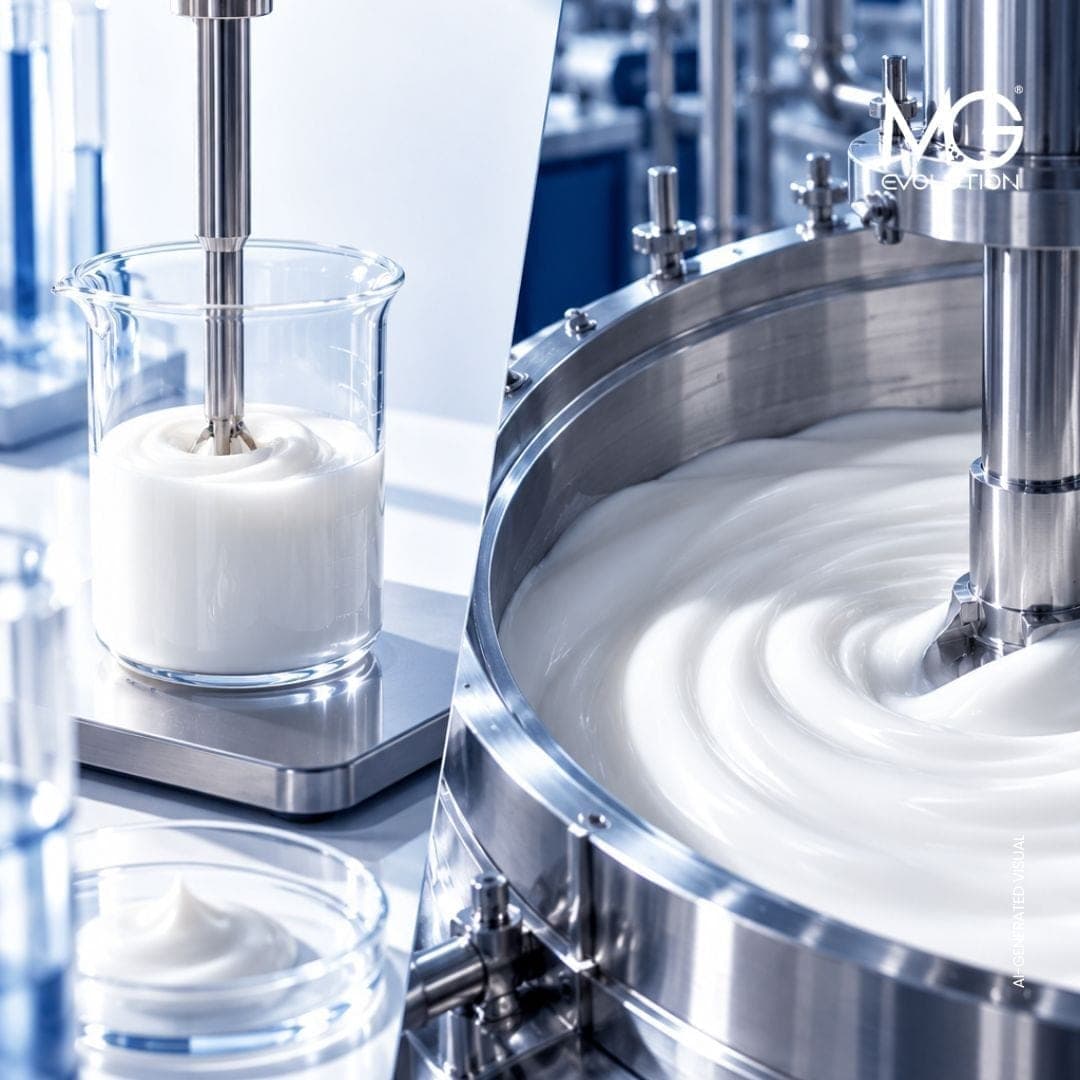
The formula is ready. The appearance, texture and sensory profile have been approved. The formulation meets the project requirements.
Does that mean production can begin?
Between developing a successful laboratory sample and moving into regular cosmetics manufacturing, there is another critical stage: scale-up, the process of transferring a formulation and its manufacturing process from laboratory to production scale.
This is where one of the most important questions in the entire project needs to be answered:
Will we achieve the same result when producing 100, 300 or 500 kg?
Scale-up is not simply about making more of the same formula
At first glance, moving from the laboratory to production may seem straightforward. Once the formula and the proportions of all raw materials have been established, it might appear that all we need to do is increase the quantities accordingly.
In practice, cosmetics manufacturing is much more complex.
A laboratory batch prepared in a small vessel and a production batch of several hundred kilograms are manufactured under different process conditions.
As the scale increases, several factors change, including:
- mixing dynamics,
- homogenisation conditions,
- the method and rate of raw material addition,
- heating and cooling rates,
- the duration of individual process stages,
- heat transfer efficiency,
- the characteristics of the equipment being used.
This is why scale-up is not simply a matter of multiplying the formula. It requires translating the process developed by R&D technologists into defined manufacturing conditions.
The same formula does not always mean the same process
A formulation defines what is in the product. Manufacturing technology defines how that product is made.
The order in which ingredients are added, temperature, mixing time, homogenisation intensity or the point at which cooling begins can all influence the properties of the finished bulk.
This is particularly important for more demanding formulation systems, including emulsions, products with specific rheological requirements and formulations in which sensory performance is an important part of the product concept.
Two batches made from the same raw materials in the same proportions should be manufactured under controlled process conditions in order to achieve defined product parameters.
Professional formulation development therefore does not end with determining the composition of the product.
What do we evaluate during scale-up?
The purpose of scale-up is to confirm that a process developed in R&D can be successfully transferred to a larger scale and to define the parameters required for manufacturing.
Depending on the type of formulation, this may include evaluating the course of the process, the behaviour of the bulk during mixing and homogenisation, temperatures at individual stages and the parameters of the finished product.
Characteristics that allow the larger-scale product to be compared with the approved reference may also be evaluated – for example, appearance, consistency, viscosity, pH or sensory properties, depending on the type of product and its defined specification.
Scale-up therefore does more than show whether a formulation can be manufactured in a larger quantity.
It helps define a process that can be reproduced across subsequent production batches.
Why does scale-up matter to the brand?
From a brand owner's perspective, scale-up may appear to be another technical stage of product development.
Its importance goes much further.
The client has approved a specific product – its appearance, texture, application and sensory experience. This is the product that should ultimately reach the market.
A properly managed scale-up process provides greater predictability before regular manufacturing begins and helps reduce the risk of differences resulting from the change in scale.
And this matters beyond the first production batch.
If the product succeeds, the next order may be larger. The brand may enter new distribution channels, increase volumes or expand into new markets.
The manufacturing process needs to be prepared for that stage of growth as well.
Product scalability is therefore not only a technological issue. It is also part of business scalability.
Consistency starts before production
Product consistency is often associated primarily with quality control of the finished batch.
In reality, its foundations are established much earlier.
The future manufacturing process should already be considered during formulation development. A formula should not only meet requirements related to active ingredients, texture or sensory performance – it should also be suitable for controlled and repeatable manufacturing at the intended scale.
This is why R&D and manufacturing should not operate as two completely separate worlds.
The earlier real manufacturing conditions are considered during development, the more effectively the entire implementation process can be designed.
From R&D to manufacturing at MG Evolution
At MG Evolution, we develop formulations with their future manufacturing in mind.
The process may include formulation development and optimisation, sample preparation and approval, testing, scale-up and the definition of technological parameters, followed by manufacturing and filling of the finished cosmetic product.
With our in-house R&D capabilities and scale-up and manufacturing capacities ranging from 30 to 1,000 kg, we can adapt the production scale to the specific stage and requirements of each project.
But the objective is not simply to manufacture a larger quantity of bulk.
It is to ensure that the knowledge developed during formulation work can be translated into a controlled manufacturing process.
A good formula must also work at scale
Approving a laboratory sample is an important milestone in every cosmetic product development project. But it is not the end of the process.
The transition from laboratory to manufacturing shows how the developed formulation performs under real production conditions.
That is why, when choosing a contract cosmetics manufacturer, it is worth asking not only about R&D capabilities or minimum order quantities.
There is another important question:
How is an approved laboratory sample transferred into regular manufacturing?
Because product quality is not defined only by how good the first sample looks and feels.
What also matters is whether its defined parameters can be successfully transferred to manufacturing and consistently maintained across subsequent batches.
A great product must be consistent.