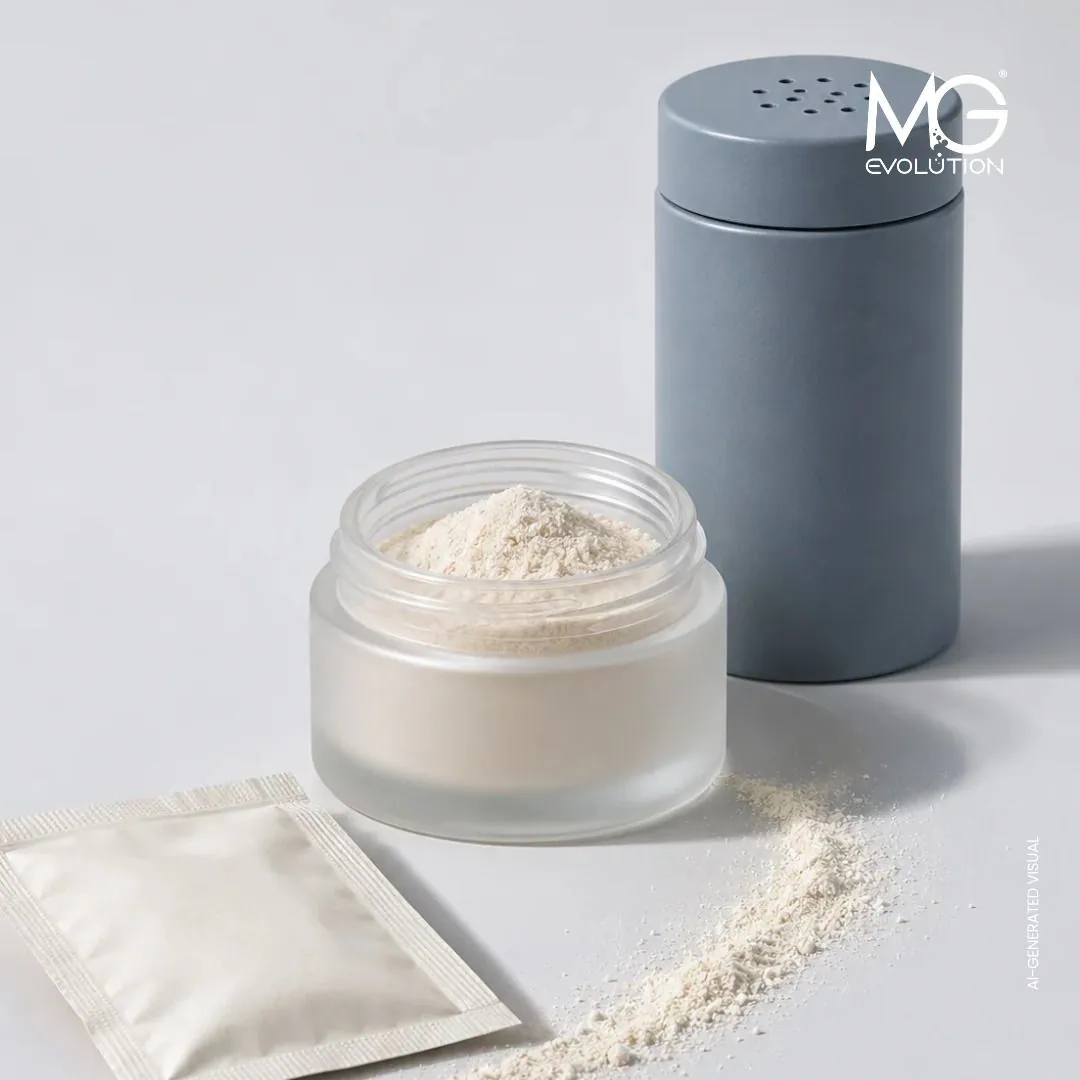
Powder shampoos, enzyme powders and deodorants give brands several ways to expand their ranges. In hair care, a powder can make a single-use sachet possible. In professional skincare, it can form the basis of a new treatment protocol.
Moving from a liquid, gel or emulsion to a powder changes how a cosmetic product is designed. A liquid shampoo has a defined consistency in the bottle, while a powder shampoo mixes with water during washing. An enzyme powder can form a paste when mixed with a separate activator, while a powder deodorant is applied directly to the skin. Each application places different demands on the formulation, dose and packaging.
Powder shampoo vs liquid shampoo
A powder shampoo is used with water and rinsed off, just like a liquid shampoo. Dry shampoo serves a different purpose. It absorbs excess sebum between washes.
When developing a powder shampoo, we select the surfactants and assess how quickly the blend wets, whether it forms clumps and how easily it spreads and rinses off. Application trials can account for different amounts of water on the hands and hair, as this can affect how the same dose behaves.
The format gives brands two ways to expand a hair care range. A single-use sachet can complement a travel kit or serve as a sample. A multi-use pack can become part of the core range, for example as a volumising shampoo for fine hair. In that case, we evaluate the washing experience and the result after drying separately. A creamy lather is part of the application experience, while root volume needs to be assessed on hair washed with the finished formulation.
Enzyme powders for professional treatment protocols
A ready-to-use gel or paste has a consistency defined during formulation. An enzyme powder can be mixed with water or a separate activator immediately before treatment. A dedicated activator gives brands the option to develop a signature treatment protocol with a defined mixing ratio, consistency and application time. The two products can be sold as a starter kit and offered separately so salons and clinics can replenish whichever runs out first.
In a two-part system, we assess each formulation separately and evaluate the mixture after combining them. At the brief stage, it helps to specify whether the mixture should form a light suspension or a paste that stays in place for the intended application time. For an enzyme-based formula, we also consider the conditions in which the selected enzyme works, including the pH of the mixture and the contact time with the skin.
Powder deodorant as an extension of a body care range
A powder deodorant can sit alongside a roll-on or aerosol in the same range. Its distinguishing feature is dry application, while odour control remains its primary function. Depending on the formulation, it can also offer a dry finish.
During development, we select ingredients for odour control and assess the properties of the powder blend. We look at how evenly it spreads, how much dust it generates during dispensing and whether it leaves visible marks on clothing. These trials help guide packaging selection and refine the features that will set the product apart within the range.
From lab sample to production. What do we check in powder blends?
Blend uniformity. Particle size, shape and density affect how powders mix. A blend can be uniform immediately after mixing, yet its components can separate during transfer or feeding into the filling equipment. During scale-up, it is therefore useful to check uniformity at several points in the process.
Moisture and stability. Exposure to moisture can cause clumping and reduce powder flow. Water activity, which reflects how much water is available to microorganisms, is also relevant to microbiological assessment. The choice of tests depends on the finished formulation, packaging and expected conditions of use. For a multi-use pack, it is worth checking how the powder behaves after repeated opening in a humid environment.
Filling and dose weight. A sachet is filled to a specified weight, while a dispenser helps the user measure out a dose from a multi-use pack. A production trial can show whether the filling equipment consistently delivers the target weight within the specified tolerance. For professional treatments, the packaging also needs to make it easy to measure the powder in the prescribed ratio to the activator.
How do you start a powder cosmetic project?
At MG Evolution®, we start by defining the product’s role in your portfolio. A shampoo for a travel kit, an enzyme powder for a professional treatment protocol and a deodorant for a body care range each require different decisions at the brief stage. That role guides the formulation, packaging format and parameters we assess before moving into production.
Developing a powder cosmetics range? Let’s talk about your project.