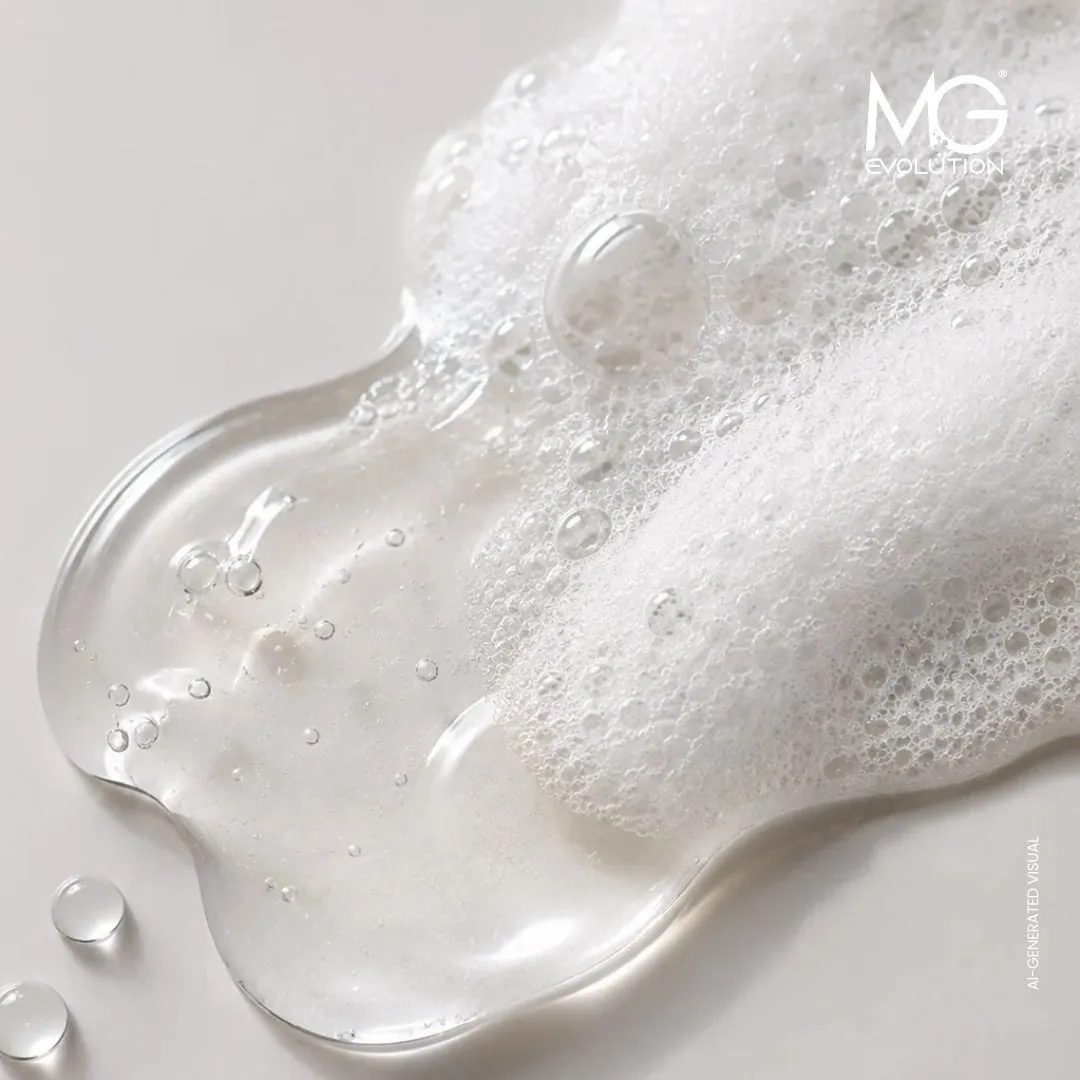
Cleansing is one of the fundamental steps in daily skin and hair care. However, modern cleansing products increasingly go beyond their primary function of removing impurities, excess sebum and cosmetic residues.
Growing consumer awareness of the skin’s protective barrier, advances in ingredient technology and increasing interest in multifunctional cosmetics are influencing the way modern cleansing formulations are developed.
The challenge for research and development laboratories is to combine effective cleansing with mildness, desirable sensory properties and additional care benefits.
How Do Cosmetic Cleansing Products Work?
Most cosmetic cleansing products are based on surface-active agents, also known as surfactants.
Their chemical structure consists of a hydrophilic part, which has an affinity for water, and a hydrophobic part, which has an affinity for oily substances.
This structure allows surfactants to reduce surface tension and facilitate the removal of impurities that are not readily soluble in water.
Under appropriate conditions and at specific concentrations, surfactants can form micelles – structures that enable the solubilisation of hydrophobic substances and facilitate their removal during rinsing.
However, the cleansing efficacy and mildness of a cosmetic product depend not only on the type of surfactant used but also on its concentration, micellar properties, interactions with other ingredients and conditions of use.
Types of Surfactants Used in Cosmetic Formulations
Surfactants can be divided into several main categories, each characterised by different chemical structures, properties and technological applications.
Anionic Surfactants
Anionic surfactants generally offer effective cleansing and foaming properties. They are widely used in shampoos, shower gels and other cleansing products.
Examples of INCI ingredients include:
Sodium Laureth Sulfate
Sodium Coco-Sulfate
Sodium Cocoyl Isethionate
Sodium Lauroyl Sarcosinate
Sodium Cocoyl Glutamate
Individual anionic surfactants can differ significantly in their mildness profiles. Therefore, the entire category should not be evaluated solely on the basis of a single ingredient.
Amphoteric Surfactants
Amphoteric surfactants are frequently used as complementary components in cleansing systems. They can influence foam quality, viscosity and the overall mildness of a formulation.
Examples of INCI ingredients include:
Cocamidopropyl Betaine
Coco-Betaine
Sodium Cocoamphoacetate
Disodium Cocoamphodiacetate
Their applications include facial cleansers, shampoos, intimate hygiene products and children’s cosmetics.
Non-Ionic Surfactants
Non-ionic surfactants can provide cleansing, emulsifying and solubilising functions. Depending on their characteristics, they are used in both rinse-off products and make-up removal formulations.
Examples of INCI ingredients include:
Coco-Glucoside
Decyl Glucoside
Lauryl Glucoside
Caprylyl/Capryl Glucoside
They are used in cleansing gels, foams, micellar waters and formulations designed for sensitive skin.
Cationic Surfactants
Cationic surfactants are primarily used in hair conditioning products. Their affinity for the negatively charged hair surface can help improve hair manageability and sensory properties.
Examples of INCI ingredients include:
Behentrimonium Chloride
Cetrimonium Chloride
Behentrimonium Methosulfate
Their incorporation into formulations containing anionic surfactants requires particular attention to ingredient compatibility.
Next-Generation Cleansing – Which Technologies Are Shaping the Future of Cleansing Products?
Amino Acid-Based Surfactants
Amino acid-based surfactants represent an important group of ingredients used in the development of modern cleansing systems. Their chemical structure combines amino acid-derived components with a hydrophobic group.
Depending on the specific raw material and formulation parameters, they can provide effective cleansing, desirable foaming properties and a favourable mildness profile.
Examples of INCI ingredients include:
Sodium Cocoyl Glutamate
Disodium Cocoyl Glutamate
Sodium Lauroyl Glutamate
Sodium Cocoyl Glycinate
Sodium Cocoyl Alaninate
Amino acid-based surfactants are used in facial cleansers, products designed for sensitive skin, shampoos and specialised cleansing formulations.
Their successful incorporation requires careful consideration of pH, concentration and interactions with other components of the surfactant system.
Biosurfactants – Biotechnology in Cosmetic Cleansing
One of the promising areas of cosmetic technology development is biosurfactants – surface-active substances produced by biological organisms, including microorganisms.
Many biosurfactants are obtained through controlled fermentation processes.
Groups being explored for cosmetic applications include:
Sophorolipids.
Rhamnolipids.
Mannosylerythritol Lipids (MEL).
Other microbial-derived glycolipids.
Depending on their chemical structure and raw material specifications, biosurfactants may provide cleansing, emulsifying, wetting or solubilising properties.
Their development creates new opportunities for designing cosmetic products that combine biotechnology with functional performance and environmental considerations.
However, the biological origin of an ingredient does not automatically guarantee greater mildness or biodegradability. These properties require individual assessment based on data relating to the specific raw material and finished formulation.
Surfactant Systems – The Importance of Ingredient Synergy
Modern cleansing products frequently combine several different surfactants.
A carefully designed surfactant system can help optimise:
Cleansing efficacy.
Mildness profile.
Foam quality and stability.
Product viscosity.
Formulation stability.
Sensory properties.
Ease of rinsing.
Interactions between surfactants can influence the formation of mixed micelles, their size and structure, as well as the concentration of free surfactant molecules in solution.
These parameters play an important role in determining how the formulation interacts with the skin’s surface.
Developing a mild cleansing product is therefore not simply a matter of selecting an individual ingredient. The design of the entire cleansing system is essential.
From Cleansing to Care – Multifunctional Cleansing Products
The growing skinification trend, which involves transferring skincare-inspired solutions into other cosmetic categories, is also influencing cleansing products.
Shampoos, shower gels, cleansing foams and emulsions are increasingly developed with additional care benefits in mind.
Humectants
Humectants have the ability to bind water. In cleansing formulations, they can contribute to skin comfort during application and help reduce the feeling of dryness after rinsing.
Examples of INCI ingredients include:
Glycerin
Betaine
Panthenol
Sodium PCA
Sodium Lactate
Saccharide Isomerate
Lipids and Refatting Ingredients
The incorporation of carefully selected lipid ingredients can influence the sensory properties of a formulation and the skin feel after cleansing.
Examples include:
Glyceryl Oleate
Squalane
Caprylic/Capric Triglyceride
Ceramide NP
Plant-derived oils
In rinse-off cosmetics, the presence of a lipid ingredient alone is not sufficient to determine its performance. Its ability to remain on the skin’s surface after rinsing is also an important consideration.
Conditioning Ingredients
Conditioning ingredients play a particularly important role in shampoos and multifunctional hair cleansing products.
They can help improve combability, reduce static electricity and enhance hair softness and smoothness.
Examples of INCI ingredients include:
Polyquaternium-7
Polyquaternium-10
Guar Hydroxypropyltrimonium Chloride
Hydrolyzed Wheat Protein
Hydrolyzed Silk
The conditioning performance of the finished product depends, among other factors, on the compatibility of these ingredients with the surfactant system and their deposition mechanisms on the hair surface.
Ingredients Supporting Skin Comfort
Depending on the intended application, cleansing formulations can be enriched with ingredients that support skin comfort.
Examples of INCI ingredients include:
Panthenol
Allantoin
Ectoin
Beta-Glucan
Inulin
Alpha-Glucan Oligosaccharide
When developing these products, it is important to consider the limited contact time of rinse-off cosmetics with the skin and the ability to deliver the intended benefits under actual conditions of use.
Does More Foam Mean More Effective Cleansing?
Foam is one of the most recognisable elements of the sensory experience associated with cleansing products.
Its volume, density, creaminess and stability can influence how consumers perceive product quality.
However, intensive foaming is not a direct indicator of cleansing efficacy.
Low-foaming cleansers, cleansing oils and cleansing emulsions can also effectively remove impurities.
From a formulation perspective, the foam profile should be tailored to the product category, application method and expectations of the target consumer.
The Importance of pH in Cosmetic Cleansing Products
pH is one of the key parameters considered during the development of cleansing formulations.
The surface of healthy skin is generally slightly acidic, which contributes to its natural protective functions.
Designing cleansing products requires consideration of both the physiological characteristics of the skin and the stability of the selected raw materials.
pH can influence:
Surfactant properties.
Formulation viscosity.
Active ingredient stability.
Preservative system efficacy.
Product tolerance profile.
The optimal pH range should be determined individually according to the product’s intended use, composition and desired performance characteristics.
An appropriate pH alone does not guarantee product mildness. The entire formulation must be evaluated.
Rheology, Texture and Sensory Properties of Cleansing Products
A modern cleansing product should not only provide effective cleansing but also deliver an appropriate sensory experience during application.
Texture development requires consideration of the formulation’s rheological properties, which influence its behaviour during dispensing, spreading and rinsing.
Important parameters include:
Product viscosity.
Flow behaviour during application.
Structural stability.
Foaming characteristics.
Ease of dispensing.
Packaging compatibility.
Depending on the product concept, formulations can be developed in a variety of formats, including transparent gels, creamy emulsions, lightweight foams, emulsifying oils and texture-transforming products.
Modern Cleansing Product Formats
Advances in formulation technology allow cosmetic brands to develop products tailored to different consumer needs and personal care routines.
Facial Cleansing Products
Gentle facial cleansing gels.
Facial cleansing foams.
Creamy cleansing emulsions.
Cleansing milks.
Make-up removing oils.
Cleansing balms.
Oil-to-milk cleansers.
Micellar waters.
Double-cleansing products.
Body Cleansing and Care Products
Shower gels.
Creamy body washes.
Shower oils.
Body cleansing foams.
Fragranced body washes.
Multifunctional 2-in-1 and 3-in-1 products.
Cleansing formulations designed for dry and sensitive skin.
Hair and Scalp Cleansing Products
Daily-use shampoos.
Shampoos for sensitive scalps.
Moisturising and conditioning shampoos.
Clarifying shampoos.
Shampoos for colour-treated hair.
Specialised trichological products.
Hair cleansing creams.
Co-wash products.
Multifunctional cleansing and conditioning formulations.
Each of these product categories requires an individual approach to surfactant system design, the selection of care ingredients and the optimisation of physicochemical parameters.
Testing and Quality Control of Cosmetic Cleansing Products
Developing a modern cleansing formulation requires verification of its properties at different stages of product development.
Depending on the product category and intended claims, the scope of testing may include:
Physicochemical stability testing.
Microbiological testing.
Preservative efficacy testing (challenge testing).
pH and viscosity control.
Packaging compatibility testing.
Foaming performance assessment.
Sensory evaluation.
Consumer use and instrumental studies.
Testing to substantiate cosmetic product claims.
Particular attention should be paid to substantiating claims relating to mildness, moisturisation, skin comfort and hair conditioning performance.
Data relating to individual raw materials provide valuable information during formulation development. However, they do not replace an assessment of the properties of the finished cosmetic product.
From Laboratory Formulation to Industrial Manufacturing
The development of cosmetic cleansing products also requires consideration of manufacturing process parameters.
The order of raw material addition, temperature, mixing intensity, incorporation of thickening agents and control of bulk aeration can influence the final properties of the product.
Excessive aeration of surfactant-containing formulations may complicate the control of cosmetic bulk parameters and subsequent filling operations.
It is also important to adapt filling technology to product viscosity and packaging format – from conventional bottles and tubes to foaming pump dispensers.
Close collaboration between R&D laboratories and manufacturing facilities allows industrial processing requirements to be considered from the earliest stages of formulation development.
Development and Manufacturing of Cleansing Products at MG Evolution®
At MG Evolution®, we develop modern cleansing formulations tailored to specific product requirements, target consumer needs and cosmetic brand concepts.
By combining the expertise of our two in-house research and development laboratories, our in-house Safety Assessor and our manufacturing facility, we provide comprehensive support throughout the product development process.
Our capabilities include:
Development of customised cosmetic cleansing formulations.
Design and optimisation of surfactant systems.
Selection of active and conditioning ingredients.
Texture and sensory property development.
Reformulation of existing cosmetic products.
Adaptation of formulations to different packaging formats.
Coordination of product testing and safety assessment.
Formulation scale-up for industrial manufacturing.
Contract manufacturing, filling and packaging of cosmetic products.
We operate within the CDMO, Private Label and White Label models, supporting both emerging cosmetic brands and established companies looking to expand or optimise their existing product portfolios.
Next-Generation Cleansing – Efficacy, Mildness and Consumer Experience
The future of cosmetic cleansing products is not solely about developing new surfactants. It is also about designing increasingly sophisticated formulation systems that combine cleansing efficacy, skin comfort, care benefits and sensory performance.
Advances in biotechnology, amino acid-based surfactants, conditioning systems and innovative product formats are creating new opportunities for cosmetic brands.
Effective cleansing and mildness are not mutually exclusive. Achieving both requires scientific knowledge, formulation expertise and appropriate technological capabilities.
Planning to develop a modern cleansing product line or improve your existing formulations? Contact MG Evolution® and discover our capabilities in cosmetic formulation development and contract manufacturing.