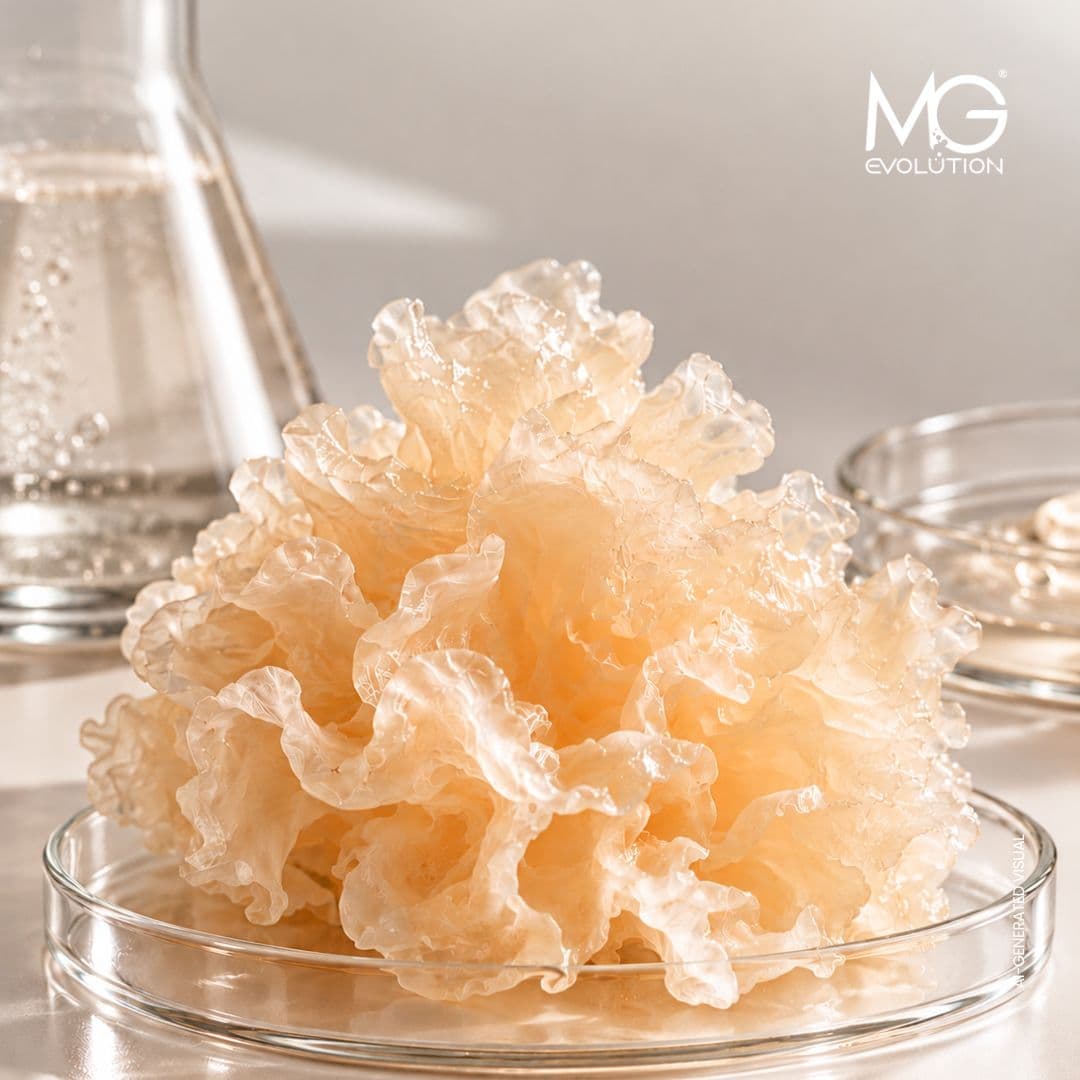
Reishi, shiitake and tremella are increasingly being explored in the development of modern skincare products. Interest in mushroom-derived ingredients is driven not only by their growing popularity but, more importantly, by the diversity of bioactive compounds they can provide.
Polysaccharides, including β-glucans, triterpenoids and phenolic compounds are being investigated for their moisturizing properties, antioxidant activity and potential applications in skincare formulations designed to support the skin barrier and address visible signs of ageing.
For cosmetic brands, this creates new opportunities to develop products targeting specific skin needs. However, successfully translating ingredient potential into a finished product requires a comprehensive approach – from raw material characterization and standardization to formulation development, safety assessment, stability testing and efficacy substantiation.
What Makes Mushrooms an Interesting Source of Cosmetic Ingredients?
Fungi represent a distinct group of organisms with diverse metabolic pathways, enabling them to produce a wide range of compounds with interesting physicochemical and biological properties.
Several groups of mushroom-derived compounds are particularly relevant to cosmetic research:
- Polysaccharides, including β-glucans – investigated for their water-binding and film-forming properties, as well as the potential effects of certain fractions on skin barrier function.
- Triterpenoids – compounds found in fungi such as those belonging to the Ganoderma genus, studied for their biological activity, including antioxidant potential.
- Phenolic compounds – of interest due to antioxidant activity observed in specific laboratory models.
- Other fungal metabolites – being explored as potential sources of new cosmetic ingredients and biotechnological solutions.
However, not all mushroom extracts exhibit the same properties. Their chemical profiles depend on several factors, including species, the part of the organism used, cultivation conditions, extraction methods and standardization parameters.
For cosmetic formulation development, the identity of an ingredient alone is therefore insufficient. Its actual composition, the concentration of relevant compounds and the consistency of quality parameters between batches are equally important.
Tremella – Polysaccharides in Hydrating Formulations
Tremella fuciformis, also known as snow mushroom, is an example of a fungus valued as a source of polysaccharides with interesting functional properties.
Their water-binding capacity has attracted attention for potential use in moisturizing skincare products. Depending on the characteristics of the raw material, these polysaccharides may also influence formulation rheology, film formation on the skin surface and sensory properties during application.
This potential is also reflected in research involving cosmetic formulations. In one reported study, an emulsion containing 0.1% Tremella fuciformis extract demonstrated improvements in skin hydration and a reduction in transepidermal water loss (TEWL) compared with a control formulation.
These findings are relevant to the development of moisturizing products, although they relate to a specific extract, concentration and formulation.
Tremella may therefore be considered for serums, essences, hydrating gels and creams designed to improve skin comfort.
The characteristics of its polysaccharides, including molecular weight, solubility and interactions with other formulation ingredients, remain important considerations.
It is also essential to distinguish between the water-binding properties of a raw material and the moisturizing efficacy of a finished cosmetic product. The latter should be supported by appropriate evidence and testing.
Reishi – Antioxidant Potential and Research into Skin Tone-Evening Applications
Ganoderma lucidum, commonly known as reishi, contains various groups of compounds, including polysaccharides and triterpenoids.
Interest in this species within cosmetic research is associated with investigations into its antioxidant activity and the effects of its extracts on selected enzymatic processes.
A study published in 2026 demonstrated antioxidant activity and tyrosinase-inhibiting potential of the investigated reishi extract under laboratory conditions.
Tyrosinase is an enzyme involved in melanin synthesis. Compounds capable of influencing its activity are therefore of interest in research into ingredients intended for skin tone-evening applications.
However, tyrosinase inhibition observed in vitro does not constitute evidence of skin-brightening efficacy in a finished cosmetic product.
Effects observed in laboratory models require further investigation, taking into account the characteristics and concentration of the extract, its behavior within the formulation and the efficacy of the finished product.
Importantly, the 2026 study also involved the development of a cosmetic emulsion containing reishi extract and the assessment of selected quality parameters, including stability and preservative efficacy.
This represents an important stage in ingredient development: moving beyond the evaluation of biological activity towards assessing the feasibility of incorporating the ingredient into a specific cosmetic formulation.
Shiitake – Research into Enzymes Associated with Skin Structure
Lentinula edodes, commonly known as shiitake, is another mushroom species being investigated for potential cosmetic applications.
A study published in 2026 evaluated the activity of a shiitake extract against enzymes involved in processes associated with the degradation of components of the skin's extracellular matrix.
In the laboratory model used, the investigated extract demonstrated 51.99% inhibition of elastase and concentration-dependent inhibition of collagenase activity.
Elastase and collagenases are enzymes involved in the degradation of extracellular matrix proteins, including elastin and collagen. These processes are relevant to the structural and mechanical properties of the skin.
The activity of extracts against these enzymes is being investigated as one of several potential mechanisms relevant to skincare targeting visible signs of ageing.
However, in vitro findings do not establish that incorporating shiitake extract into a cosmetic product protects collagen or elastin in human skin.
Such effects would require further investigation using appropriate biological models and evidence supporting the specific claims made for the finished product.
The study also included the development of a model cream formulation and an assessment of its stability under the applied testing conditions.
This illustrates an important direction in mushroom-derived ingredient research, where the investigation of biological activity is increasingly combined with the evaluation of practical formulation feasibility.
Mushrooms and Skin Longevity – Where Does Potential End and Evidence Begin?
Skin longevity is an emerging direction in skincare development, shifting the focus from correcting visible signs of ageing towards supporting the long-term maintenance of healthy skin function.
This approach encompasses growing interest in mechanisms associated with biological ageing, skin resilience to environmental stressors and the preservation of protective functions.
Within this context, mushroom-derived ingredients represent an interesting area of investigation due to the antioxidant activity of selected compounds, the functional properties of polysaccharides and the potential influence of certain metabolites on specific biological processes.
However, an important distinction must be made.
Research demonstrating free-radical scavenging activity, enzyme inhibition or moisturizing properties does not provide sufficient evidence to conclude that an ingredient slows the biological ageing of the skin.
Furthermore, these mechanisms are not interchangeable indicators of skin longevity. Each describes a different aspect of skin function and requires its own scientific interpretation.
From a product development perspective, longevity may provide a relevant conceptual direction, but specific product claims must be supported by appropriately designed studies.
This approach allows brands to build credible product communication without extending laboratory findings to benefits that have not yet been demonstrated.
From Extract to Finished Cosmetic Product – What Determines Formulation Success?
Promising biological activity is a starting point, not definitive evidence of an ingredient's value in a finished cosmetic product.
Several interconnected factors must be considered throughout the product development process.
Raw Material Selection and Standardization
Extracts obtained from the same species may differ in chemical composition, the concentration of specific fractions and physicochemical characteristics.
Standardization helps reduce batch-to-batch variability and improves predictability during formulation development.
For naturally derived ingredients, quality control is particularly important, including raw material identification, purity assessment and monitoring of potential contaminants.
Formulation Compatibility
Solubility, pH, the presence of electrolytes, interactions with emulsifiers and thickeners, and the ingredient's effects on viscosity and sensory performance may determine its suitability for a particular formulation.
An ingredient demonstrating promising activity in laboratory testing may not necessarily retain the expected properties once incorporated into a complex cosmetic formulation.
Stability and Safety
The finished formulation requires appropriate assessment of physicochemical stability, microbiological quality, packaging compatibility and safety.
Depending on the product's characteristics, preservative efficacy testing may also be necessary.
The properties of the extract itself cannot replace these assessments.
Substantiation of Product Claims
Research conducted on an individual ingredient may contribute to the scientific rationale for its selection, but it does not automatically establish the efficacy of the finished cosmetic product.
Under European Union requirements governing cosmetic claims, communicated product benefits must be supported by adequate and verifiable evidence.
The type and extent of supporting documentation and testing should be appropriate to the specific claim.
Not every claim requires a separate clinical study. However, information communicated to consumers must be accurate, reliable and adequately substantiated.
How Can Mushroom-Derived Ingredients Support Cosmetic Portfolio Development?
For cosmetic brands, the greatest value lies not simply in incorporating a mushroom extract into a formula, but in using its specific properties as part of a coherent product concept.
Tremella polysaccharides may be considered for moisturizing formulations, reishi extracts for projects exploring antioxidant and skin tone-evening potential, and shiitake for skincare concepts targeting visible signs of ageing.
Each direction requires individual raw material assessment, appropriate formulation technology and verification of the finished product's performance.
It is equally important to align ingredient selection with the overall objectives of a cosmetic line.
An ingredient's properties should support a clearly defined skincare function rather than serve solely as a marketing feature.
A well-planned formulation development process connects ingredient potential with specific skin needs, consumer expectations and credible brand communication.
MG Evolution – From Product Concept to Finished Formulation
At MG Evolution, we approach cosmetic product development by combining ingredient knowledge, formulation expertise and appropriately planned testing.
We support brands in developing formulations aligned with their product objectives, intended applications and market positioning.
Throughout the process, we consider requirements relating to stability, safety, sensory performance and manufacturing feasibility.
Mushroom-derived ingredients are one example of how advances in ingredient research can inspire new directions in cosmetic product development.
Planning a new skincare line or exploring ingredients with interesting formulation potential?
Let's discuss how MG Evolution can help transform your concept into a cosmetic product tailored to your brand's needs.