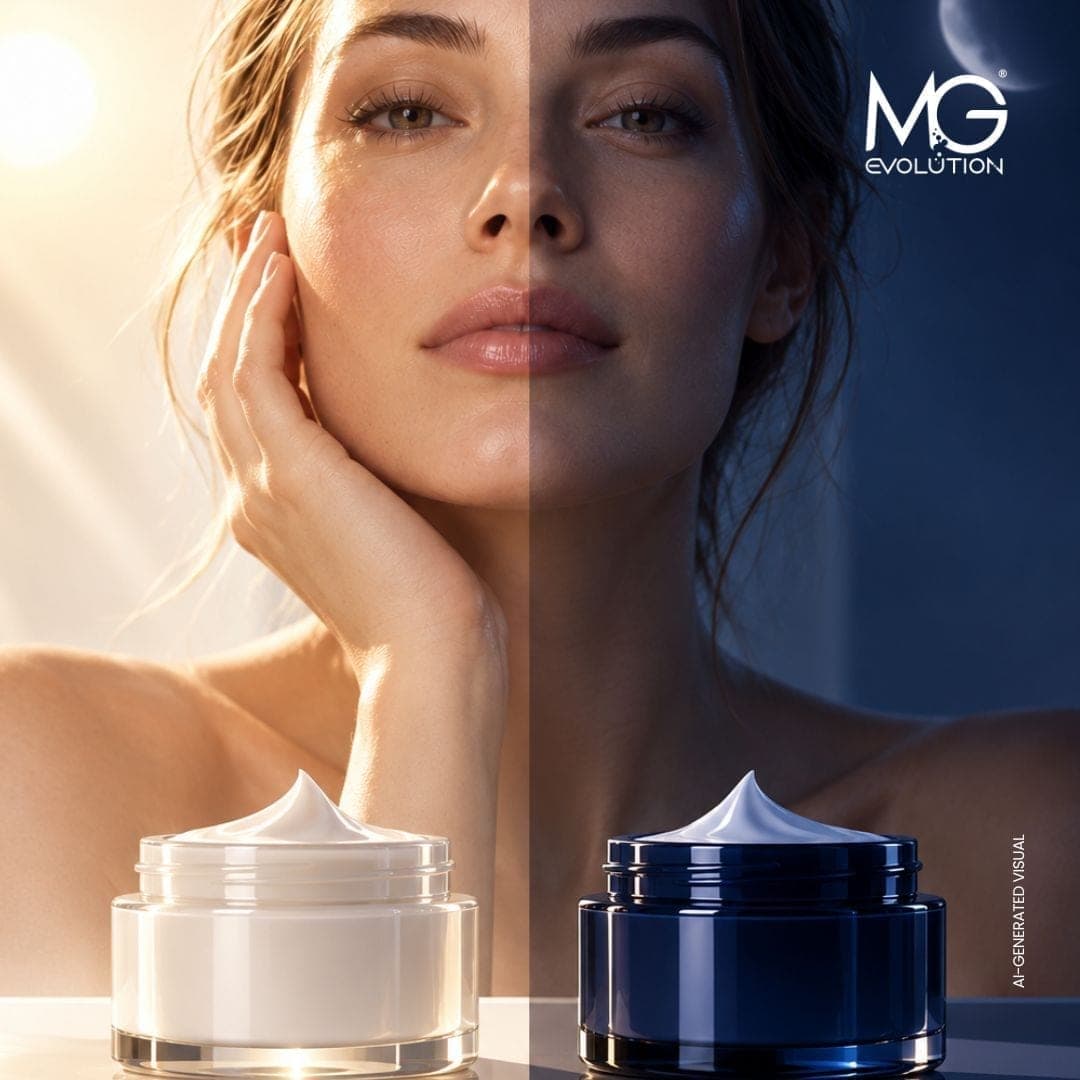
The division between day and night skincare is so common that it is easy to see it primarily as a marketing concept. Two products, two applications, two places in a skincare routine.
But are day and night creams really differentiated only by what is written on the packaging?
Not entirely. Skin does not function in exactly the same way throughout the day. Some of its physiological processes follow circadian rhythms. Skin chronobiology therefore raises an interesting question for R&D: when developing a cosmetic product, should we consider not only its composition and intended function, but also the timing of application?
Skin chronobiology – skin has its own clock
We usually associate circadian rhythms with the sleep-wake cycle. However, molecular clocks also operate within skin cells, including keratinocytes, melanocytes and fibroblasts.
Current research indicates that circadian regulation is associated with epidermal renewal, skin barrier function, immune activity, cell proliferation and mechanisms involved in the response to and repair of DNA damage.
From a biological perspective, this means that skin does not remain in exactly the same functional state throughout the 24-hour cycle.
And this is where the DAY/NIGHT distinction becomes much more interesting than a simple marketing concept.
What actually changes in the skin over 24 hours?
One of the best-described examples is skin barrier function.
Studies in healthy volunteers have demonstrated rhythmic variations in transepidermal water loss (TEWL), skin surface pH and skin temperature. Differences in epidermal permeability have also been observed, with studies reporting higher permeability in the evening compared with the morning.
From a cosmetic formulation perspective, this is an interesting observation.
If barrier properties change over time, application timing may potentially be one of the factors influencing the conditions in which a formulation remains on the skin and its ingredients interact with it.
This does not mean, however, that every ingredient will penetrate the skin more effectively in the evening or that every product applied at night will be more effective.
Ingredient penetration also depends on its physicochemical properties, concentration, formulation type, delivery system and the condition of the epidermal barrier.
Chronobiology therefore does not replace the principles of cosmetic formulation. It potentially adds another variable.
Does skin really “regenerate at night”?
This is one of the most frequently repeated statements about night skincare. From a scientific perspective, however, it is an oversimplification.
Skin chronobiology extends far beyond variations in TEWL or temperature.
Molecular clocks operating in skin cells are associated with the regulation of processes including cell proliferation, immune responses, oxidative stress and mechanisms involved in the response to DNA damage.
There is no single biological switch that activates “skin regeneration” after sunset.
Individual processes have their own rhythmic patterns, governed by complex molecular mechanisms.
From an R&D perspective, a more relevant question is therefore:
Which processes in the skin show circadian rhythmicity, and can this knowledge be used when designing a cosmetic product?
Melatonin in the skin – more than a sleep hormone
One particularly interesting example of the relationship between skin and circadian biology is melatonin.
It is most commonly associated with the pineal gland and regulation of the sleep-wake cycle. However, the skin has its own local melatoninergic system.
Skin cells can synthesise melatonin, metabolise it into biologically active metabolites and respond to its activity.
Local melatonin activity is being investigated in relation to oxidative stress regulation, mitochondrial function, epidermal homeostasis, photoprotection and processes associated with skin ageing.
Does this mean that a cosmetic containing melatonin should only be used at night?
No.
The relationship between melatonin and the circadian system is not, by itself, evidence that topically applied melatonin will be more effective at a particular time of day. This is an important distinction between understanding a biological mechanism and demonstrating the efficacy of a finished cosmetic product.
Could application timing become a cosmetic formulation parameter?
When developing a new formulation, R&D teams evaluate multiple variables: active ingredients, concentrations, compatibility, stability, formulation system properties, sensory profile, packaging and testing strategy.
Skin chronobiology potentially adds another question to this list:
WHEN will the product be applied?
If a product is specifically designed for night-time skincare, its development can take into account not only a NIGHT claim on the packaging, but also the biological and practical context of its intended use.
Similarly, a daytime cosmetic can be developed with consideration for the skin's exposure to UV radiation, environmental pollution and other factors associated with oxidative stress.
With this approach, DAY/NIGHT is no longer simply part of product communication. It can become one of the assumptions behind product development.
Do we therefore need separate day and night creams?
Not necessarily.
The fact that skin exhibits circadian rhythms does not mean that every cosmetic line requires two separate creams.
In many cases, one well-designed formulation may be suitable for both morning and evening use.
Chronobiology should therefore not become an argument for creating an additional SKU without a clear rationale.
Instead, it can provide knowledge that helps determine whether separating DAY and NIGHT functions has a biological, formulation and business rationale for a specific product concept.
Chronocosmetics – an interesting direction, but evidence matters
Designing cosmetics with the biological rhythms of the skin in mind is an interesting direction for product development.
Current research provides substantial evidence for the existence of circadian clocks in the skin and rhythmic variation in multiple physiological processes. There is considerably less clinical evidence, however, showing that applying the same ingredient or finished product at a particular time results in a significantly better outcome.
This distinction is essential:
A biological mechanism is not yet proof of product efficacy.
If application timing is intended to become part of a product concept or communication strategy, it should also be considered when designing the testing strategy.
This is particularly important when developing product claims. Ingredient selection and scientific literature supporting their mechanisms can provide a rationale for a concept, but they do not replace testing of the finished formulation.
Skin chronobiology and the development of new formulations
Chronobiology does not mean that every cosmetic product should now have separate DAY and NIGHT versions.
It does, however, show that we can start asking more questions during product development.
Not only:
WHICH active ingredient? At WHAT concentration? In WHICH formulation system?
But also:
WHEN will the product be used?
This creates an interesting perspective for new cosmetic projects, particularly those designed to combine advanced active ingredients, a defined mechanism of action and an appropriately planned testing strategy.
Innovation does not always mean introducing another new active ingredient.
Sometimes it begins with a better understanding of skin biology and translating that knowledge into a well-designed formulation.
Want to develop a cosmetic product based on skin chronobiology?
At MG Evolution, product development begins with formulation and technological assumptions, which we then translate into a specific formula, manufacturing process and appropriately designed testing strategy.
Want to develop a product or cosmetic line based on skin chronobiology? Let’s discuss how to translate this concept into formulation, technology and a well-designed testing strategy.