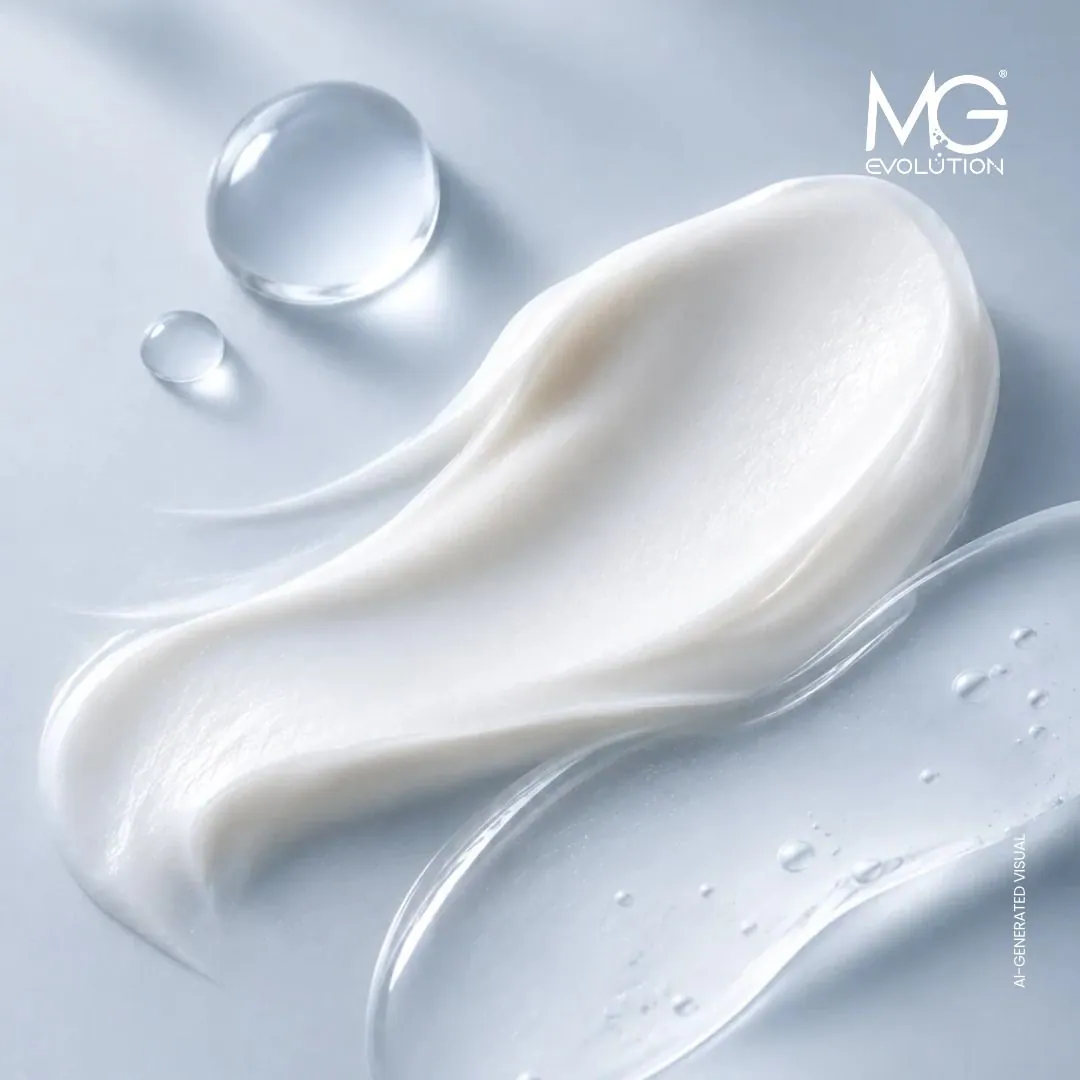
After years of popularity of Glass Skin, characterised by intensely hydrated, luminous skin, Cloud Skin is gaining momentum. This trend is reshaping not only consumer expectations regarding skin appearance but also the approach to cosmetic formulation development.
Hydration, optical smoothing, a velvety finish and controlled shine are becoming starting points for developing new textures, product formats and technological solutions.
Cloud Skin is part of a broader direction in the beauty industry – Skin Perfecting Skincare, a category of products combining skincare benefits with immediate visual effects.
What Is Cloud Skin and How Does It Differ from Glass Skin?
Cloud Skin is a beauty trend focused on achieving hydrated, visibly smooth skin with a soft, satin-matte finish. Its defining feature is subtle light diffusion, creating a soft-focus effect that optically reduces the appearance of pores and minor skin imperfections.
Unlike Glass Skin, which emphasises intense radiance, Cloud Skin focuses on balancing hydration with shine control.
However, this does not represent a return to traditional, heavily mattifying cosmetics. The essence of the trend lies in combining skin comfort, barrier support and carefully designed finishing properties.
Skin Perfecting Skincare – Bridging Skincare and Colour Cosmetics
The development of hybrid beauty products is increasingly blurring the boundaries between skincare and makeup. Skincare products can support skin condition with regular use while also improving its appearance immediately after application.
Within the Skin Perfecting Skincare category, particular importance is placed on:
Hydration and skin barrier support.
Optical reduction in the appearance of pores and skin imperfections.
Control of excessive shine.
Lightweight, velvety finishes.
Compatibility with subsequent skincare and makeup application.
Sensory properties of cosmetic formulations.
This approach creates new opportunities for portfolio development, both for established skincare brands and for companies looking to introduce hybrid beauty products.
Which Cosmetic Products Align with the Cloud Skin Trend?
Cloud Creams & Whipped Emulsions – Lightweight, Fluffy Textures
Cloud Creams are lightweight creams and emulsions distinguished by their soft, fluffy textures and comfortable application.
Achieving these structures requires careful selection of emulsifiers, emollients, rheology modifiers and processing parameters. Depending on the product concept, controlled aeration of the cosmetic formulation may also be considered.
These formulations can incorporate ceramides, ectoin, squalane, beta-glucan or hyaluronic acid, combining skincare benefits with a lightweight sensory profile.
Milky Serums – Lightweight Emulsions and Essences
Milky serums and essences are low-viscosity emulsions that combine hydrophilic and lipophilic ingredients within a lightweight formulation.
They offer an alternative to conventional water-based serums, particularly in products designed to provide hydration and support the skin barrier.
The formulation challenge lies in achieving adequate emulsion stability, ease of application and a comfortable finish without leaving an excessively greasy or sticky film on the skin.
This product format is particularly relevant to daily skincare routines, barrier-supporting product lines and cosmetics inspired by the Korean beauty market.
Blurring Creams – Skincare with a Soft-Focus Effect
Blurring Creams combine the benefits of conventional skincare creams with an immediate optical smoothing effect.
Functional ingredients used to achieve this effect include:
Spherical silica.
Boron nitride.
Cellulose microspheres.
Selected mineral powders.
Selected elastomers.
The effectiveness of these ingredients depends not only on their type but also on particle size, geometry, concentration, dispersion and compatibility with other formulation components.
A well-designed formulation can optically reduce the appearance of pores and minor skin imperfections without relying on high-coverage pigments.
Soft Matte SPF – Sun Protection with a Satin Finish
Sunscreen products represent another category with development potential in response to the Cloud Skin trend.
Developing SPF formulations with a lightweight, velvety finish requires balancing effective UV protection with desirable sensory properties.
The selection of emollients, UV filters, film-forming agents and shine-modifying ingredients is particularly important.
The incorporation of soft-focus ingredients must not compromise the uniformity of the protective film. Sun protection performance must be confirmed through appropriate testing of the finished product.
Cream-to-Powder – Transformative Cosmetic Textures
Cream-to-Powder formulations change their sensory profile during application, transitioning from a creamy, easy-to-spread texture to a velvety, powder-like finish.
This effect can be achieved through the careful selection of emollients, waxes, volatile components and powdered ingredients.
The technology has applications beyond colour cosmetics, including skincare primers, smoothing balms and hybrid beauty products.
Which Ingredients Are Used in Cloud Skin Formulations?
Developing cosmetics aligned with the Cloud Skin trend requires combining active ingredients with functional raw materials responsible for formulation structure, sensory properties and optical performance.
Hydrating ingredients: hyaluronic acid, polyglutamic acid, glycerin, betaine and ectoin.
Skin barrier-supporting ingredients: ceramides, cholesterol, squalane and phospholipids.
Soothing ingredients: beta-glucan, panthenol and Centella Asiatica extract.
Lightweight emollients: Coco-Caprylate/Caprate, C13-15 Alkane and Dicaprylyl Carbonate.
Optical and sensory modifiers: silica, boron nitride, cellulose, rice starch and tapioca starch.
There is no universal ingredient combination that defines Cloud Skin cosmetics. The final composition should reflect the product's intended use, target audience, desired performance and technological requirements.
How Does the Soft-Focus Effect Work in Cosmetics?
The soft-focus effect relies on the optical properties of selected cosmetic ingredients. Carefully selected particles scatter light reaching the skin's surface, reducing the visual contrast associated with skin irregularities.
As a result, the skin may appear smoother, while pores and fine lines may become less visible.
Unlike conventional high-coverage makeup, this effect does not necessarily depend on pigments. Instead, it can be achieved by engineering the optical properties of the formulation.
It is important to distinguish the soft-focus effect from long-term skincare efficacy. Optical smoothing improves the visible appearance of the skin without necessarily altering its underlying structure.
From Cosmetic Texture to Industrial-Scale Manufacturing
Developing an innovative texture in the laboratory is only the first stage of cosmetic product development. Maintaining its properties throughout formulation scale-up, industrial manufacturing and filling is equally important.
For cosmetics inspired by the Cloud Skin trend, key technological considerations include:
Physicochemical formulation stability.
Rheological properties and viscosity.
Uniform dispersion of functional ingredients.
Homogenisation parameters.
Consistency of sensory properties across production batches.
Packaging compatibility.
Preservation of the desired texture during filling.
Depending on the intended product claims, the testing process may also include assessments of skin hydration, transepidermal water loss (TEWL), skin gloss and the visible appearance of pores and skin irregularities.
A properly designed testing strategy helps align marketing claims with the demonstrated performance of the finished cosmetic product.
Cloud Skin as a Product Development Opportunity for Beauty Brands
Portfolio differentiation does not have to rely exclusively on introducing new active ingredients or increasing their concentrations.
Texture, sensory performance, application experience and visual effects can be equally important elements of product positioning.
The Cloud Skin trend creates opportunities for developing:
Skin barrier-supporting skincare lines.
Hybrid beauty products.
Soft-focus skincare formulations.
Advanced sun protection products.
K-beauty-inspired cosmetics.
Premium skincare with distinctive sensory profiles.
The potential of this category extends beyond a single aesthetic trend. Skin Perfecting Skincare enables brands to develop products that address both long-term skincare needs and consumer expectations for immediate visual results.
Cloud Skin Cosmetic Development and Contract Manufacturing at MG Evolution®
MG Evolution® is a Polish contract manufacturer of cosmetics and medical devices, operating across CDMO, Private Label and White Label business models.
In our R&D laboratories, we develop customised cosmetic formulations, taking into account active ingredient performance, sensory properties, rheology and technological requirements.
Our in-house research and development facilities and manufacturing plant enable us to manage projects from initial product concept, formulation development and testing through to scale-up, industrial manufacturing and filling.
Are you planning to launch a Cloud Skin or Skin Perfecting Skincare collection, or develop an innovative skincare product line?
Contact MG Evolution® to explore our cosmetic formulation development and contract manufacturing capabilities.
We create cosmetics. We build brands.