A well-developed formula is the foundation of a good cosmetic product. Yet the manufacturing process also determines whether the finished product achieves its intended consistency, viscosity and stability. Equipment, process parameters and the expertise of the team transferring a formulation from the laboratory to industrial production all play a role.
At MG Evolution®, we combine laboratory expertise with manufacturing technology to achieve the required product properties, from the initial production run through to subsequent batches.
The Formula Defines the Ingredients. The Process Defines How They Come Together.
A list of raw materials and their proportions is only part of the manufacturing instructions. A defined manufacturing process is also needed to establish how those ingredients should be combined to obtain the intended product.
Key factors include:
the order and method of raw material addition;
temperature at each stage;
mixing time and intensity;
homogenisation conditions;
the heating and cooling profile of the bulk product.
These parameters must be tailored to each formulation. Creams, lotions and cleansing products may require different processing conditions. Cosmetic development therefore involves both formulating the product and establishing how it should be manufactured.
What Role Do Homogenising Mixers Play?
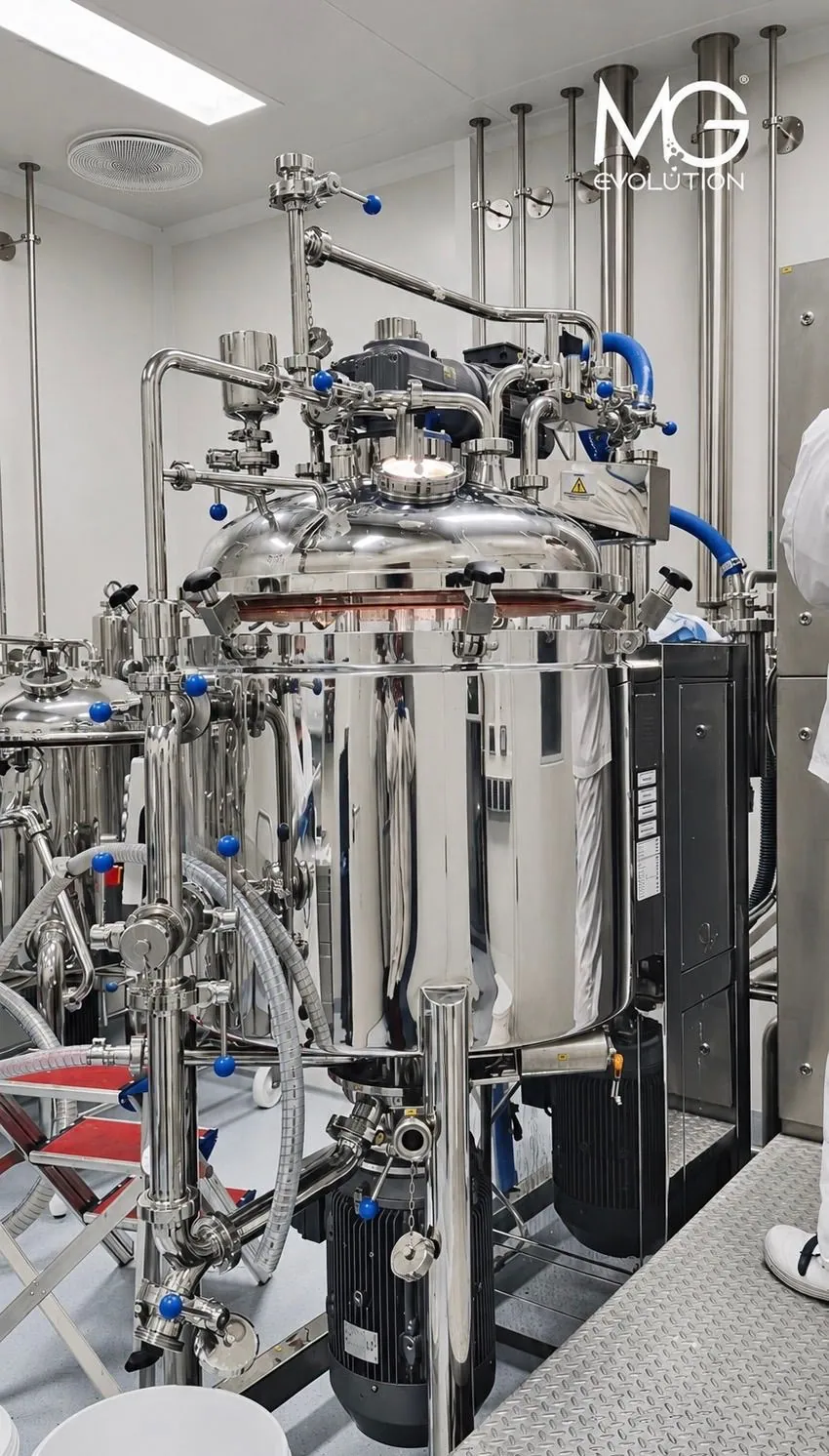
Homogenising mixers are an important part of MG Evolution®’s manufacturing equipment. They help achieve a uniform dispersion of ingredients throughout the bulk product.
For emulsions, including many creams and lotions, homogenisation breaks up and disperses one phase within another. Appropriate processing conditions help create the intended product structure.
However, longer or more intensive homogenisation does not always produce a better result. Parameters must suit the formulation and the properties of its raw materials. Using a homogeniser alone does not confirm product stability; this must be assessed through appropriate testing.
Quality therefore depends on the combination of equipment capabilities, a well-developed manufacturing process and process control.
From Laboratory Sample to Industrial Production
An approved laboratory sample establishes the expected product properties. The next challenge is to reproduce them in a larger batch.
This is the purpose of scale-up: transferring a manufacturing process to a larger production scale. It involves more than increasing raw material quantities proportionally. Larger batches have different mixing, heating and cooling conditions, so process parameters must be adapted to the equipment and batch size.
The aim is to manufacture a product that meets its agreed specifications. Depending on the formulation, these may include appearance, odour, pH and viscosity measured under defined conditions.
At MG Evolution®, scale-up brings together our R&D team, manufacturing capabilities and quality control. This allows us to verify that the product meets the required parameters when manufactured at a larger scale.
Batches from 30 to 1,000 kg: Flexibility for Growing Brands
MG Evolution®’s equipment enables the manufacture of batches ranging from 30 to 1,000 kg. This allows production volumes to match the project’s stage of development, from smaller initial runs to larger orders.
For cosmetic brands, this means the flexibility to begin with a lower volume and increase production as sales grow. Maintaining the agreed quality requirements throughout this transition is essential.
Batch weight does not translate into a fixed number of finished products. The number of units depends on factors such as the fill quantity per pack and the properties of the bulk product.
Consistency Requires Collaboration
For a brand, the quality of the first batch matters just as much as the consistency of subsequent deliveries. Customers who repurchase a cosmetic expect a familiar texture and the same experience during use.
At MG Evolution®, our R&D team, physicochemical laboratory and quality control department work together to verify that products meet defined requirements.
An established manufacturing process, production documentation and parameter checks allow each batch to be assessed against the agreed specifications. Consistency is the result of a controlled process supported by suitable equipment and experienced people.
What Does This Mean for Your Brand?
When choosing a cosmetic manufacturer, consider both formulation development capabilities and the infrastructure needed to bring a product into production. Key questions include how the manufacturer approaches scale-up, monitors product parameters and supports increasing production volumes.
At MG Evolution®, we support product development from formulation through to manufacturing, filling and packaging. We combine our teams’ expertise with our technical capabilities to turn project requirements into finished cosmetic products.
Planning your own cosmetics line or looking for a partner to scale up production? Contact MG Evolution® to discuss your project and find the right scope of support.