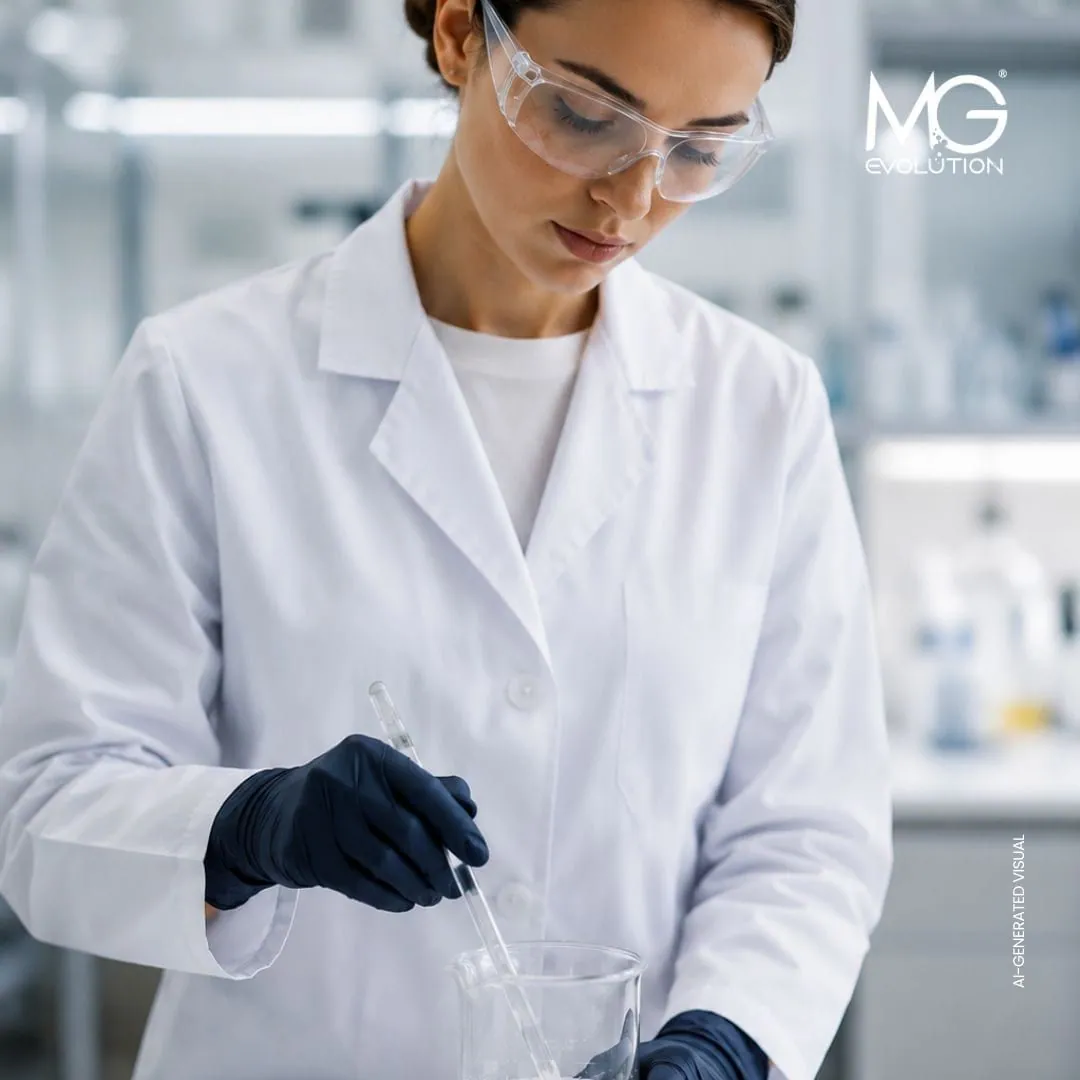
Peptides. Ceramides. Ectoin. Niacinamide. Ferments.
Active ingredients are an important part of cosmetic product development and often form one of the foundations of a product concept. They can address specific skin needs, support product positioning, and play an important role in product communication.
However, the presence of a recognized active ingredient on the INCI list alone does not determine the properties or performance of the finished cosmetic product.
Between selecting an active ingredient and creating a product whose performance can be responsibly communicated lies one of the most important stages of product development: designing the complete formulation and validating it appropriately.
Active ingredients function within a specific formulation environment
In R&D, an ingredient is not evaluated in isolation from the rest of the formulation.
Its form and properties, stability, required pH, processing temperature, solubility, and compatibility with other formulation components all matter.
The manufacturing process itself is equally important.
The order in which raw materials are added, temperatures at individual processing stages, mixing time and method, and homogenization can all influence the final properties of the product.
This is why two formulations containing similar active ingredients do not necessarily deliver identical properties or performance.
What matters is the entire system in which an ingredient is used.
Raw material data is the starting point
When developing a cosmetic product, data provided by raw material suppliers is an important source of knowledge. It may include information on ingredient properties, mechanisms of action, recommended formulation conditions, and results from available studies.
This information is highly valuable during R&D, but it should not automatically be considered evidence of the properties of the finished product.
If a particular benefit has been demonstrated for a specific raw material, this does not necessarily mean that every cosmetic product containing that ingredient will deliver exactly the same effect.
A finished formulation is a much more complex system.
Therefore, during product development, the question should not only be:
“Which active ingredient do we want to use?”
An equally important question is:
“What effect do we want to achieve, and how can we design a formulation that allows us to use the potential of the selected ingredients?”
From formulation to claim
The next step is determining what can be communicated to consumers.
A cosmetic claim should not be based solely on the presence of a recognized ingredient on the INCI list. It should be supported by appropriate and verifiable evidence relevant to the benefit being claimed.
This is why, when developing a formulation, it is important to consider not only the composition of the product but also the intended claims and how they will be substantiated.
Depending on the product and its planned communication, this may include consumer use tests, instrumental testing, dermatological testing, or other appropriately selected assessment methods.
This represents an important shift in perspective.
Testing should not be treated simply as the final item on a checklist before a product reaches the market. The strategy for substantiating product performance should be considered from the product development stage.
If we intend to communicate a specific benefit, we should determine early in the process how that benefit will be verified.
Packaging is also part of product development
Packaging can also influence how a formulation maintains its properties over time.
Exposure to light and air, the dispensing system, compatibility between the packaging material and the cosmetic formulation, and the way the product is used can all affect its stability and quality.
This is why cosmetic product development does not end when the formulation is approved.
The formulation, manufacturing process, packaging, testing, and intended communication should be considered as interconnected elements of one product development process.
Ultimately, the finished product matters
Consumers do not use an individual peptide, ceramide, or extract.
They use a finished cosmetic product.
Its properties, stability, safety, application experience, and substantiated performance shape the final consumer experience.
At MG Evolution®, we therefore approach product development from a broader perspective than the ingredient list alone.
We combine R&D, raw material selection, formulation development, testing, documentation, packaging selection, and manufacturing to create cosmetic products aligned with specific product and communication objectives.
Develop and manufacture with MG Evolution® cosmetic products designed for specific performance and supported by appropriately selected testing.